UP subsidy guidance
For an eligible 3 kW+ residential system: central CFA can be ₹78,000 and UP may add up to ₹30,000. We help with the official workflow; approval remains with the government and DISCOM.
Check official portal ↗Residential solar · Uttar Pradesh
Find the right rooftop system, see your subsidy estimate and compare the EMI with your current electricity bill—in under a minute.
An eligible bank loan can finance the installation so the upfront payment may be very low or ₹0 in an approved structure. You then pay the bank EMI while solar reduces the variable electricity bill. This is financing—not a free system: bank approval, margin, interest, remaining grid charges and actual generation still apply.
For an eligible 3 kW+ residential system: central CFA can be ₹78,000 and UP may add up to ₹30,000. We help with the official workflow; approval remains with the government and DISCOM.
Check official portal ↗Compare a bill-first on-grid system, a battery-backed hybrid system and an independent off-grid system. The correct choice starts with outage needs, grid availability and budget.
Compare all three ↓Roof assessment, system design, installation, protection, net-meter coordination, monitoring handover and after-sales escalation—mapped step by step.
See the 7-step process ↓India solar economics calculator
The 3 kW installation estimate is ₹2,00,000. Booking-time discounts may apply after survey. State tariffs are planning references and remain editable outside UP.
UP FY 2026–27 slab rate is calculated from your units; fixed charges are excluded because solar normally does not remove sanctioned-load charges.
Your solar economics
Estimated solar generation each month
Booking-time discount may reduce the final price after the roof survey and equipment selection.
Price basis: ₹2,00,000 for 3 kW. Discounts may be applied at booking after survey; taxes, structure and site-specific extras must be confirmed in writing.
Break-even and cumulative value based on your inputs.
Indicative seasonality; monsoon and local shade change actual output.
*Planning estimate only—not a quote, generation guarantee, financing offer or subsidy approval. Fixed charges remain on most bills. State reference rates may reflect a representative household and must be checked against your own bill. Surplus export credit depends on the applicable DISCOM settlement rules.
UP FY 2026–27 rate card
Urban domestic variable charge; fixed charge is separate. Rural rates are lower and selectable in the calculator.
*Net-meter credits are normally adjusted against later consumption first; ₹2 applies to credits left at settlement under current UPERC treatment.
UP sunlight → household units
UPNEDA says 1 kW typically produces 4–5 units/day and needs about 10 m² (~108 sq ft) of shadow-free roof.
120–150 units/month · ~100–110 sq ft roof
240–300 units/month · ~200–220 sq ft roof
360–450 units/month · ~300–330 sq ft roof
600–750 units/month · ~500–550 sq ft roof
Transparent package pricing
Indicative turnkey pricing for a standard shadow-free rooftop: DCR panels, inverter, galvanised structure, protection, wiring, net-meter paperwork and installation. Final price is confirmed in writing after a roof survey.
Best for 150–300 units/month
Best for 400–700 units/month
Best for 700–1,000 units/month
Subsidy is capped at 3 kW — a 5 kW or 7 kW system receives the same ₹1,08,000, so the extra capacity is paid at full price. Prices assume a standard RCC roof with a shadow-free area and a single inverter run; high-rise lifts, long cable routes, elevated structures and non-standard roofs are quoted separately.
From roof survey to net meter and subsidy support, you always know what happens next.
Your solar journey
We check shade, structure, sanctioned load and recent bills.
Application support on the official PM Surya Ghar workflow.
Technical feasibility and sanctioned-load checks are completed.
Panel layout, mounting, inverter and protection are finalized for your roof.
Panels, structure, cabling, earthing and safety devices are installed.
The DISCOM inspects, meters and commissions the on-grid system.
We help complete the claim and track it; payment is subject to government verification.
Major Indian solar terminology
These names describe how the complete solar system connects to the electricity grid and battery. Start with your real goal: reduce the bill, keep essentials running in a power cut, or operate independently from the grid.
Connected to the DISCOM grid without a battery. Solar serves your home first and eligible surplus can move through the net meter. Usually the simplest and lowest-equipment-cost route for reducing bills.
Combines solar, the grid and battery storage. A correctly designed hybrid system can isolate safely during a grid failure and keep selected essential circuits running.
A standalone solar-and-battery system that does not depend on the DISCOM grid for operation. It must be sized for daily loads, night use, poor-weather reserve and battery autonomy.
| Quick comparison | On-grid | Hybrid | Off-grid |
|---|---|---|---|
| Primary goal | Reduce bill | Bill saving + backup | Energy independence |
| Equipment cost | Lowest of the three | Higher because of battery and controls | Usually highest for autonomy |
| Net metering / export | Yes, subject to DISCOM approval | Possible when approved and configured | No grid export |
| Government rooftop CFA | Grid-connected residential route | Verify solar portion and DISCOM rules; do not assume battery subsidy | Not the standard grid-connected CFA route |
Then choose capacity
These are quick planning guides from the material you supplied. The roof survey decides the final capacity, system type and equipment.
For a smaller family and essential loads.
For a typical 4–6 person home with everyday appliances.
For a villa, larger family, ACs or growing energy needs.
This quick UP plan sizes solar against your monthly meter use at 4.5 units/day per kW. The full calculator above lets you change state, tariff, payment mode and assumptions.
Solar learning centre
Explore the panel categories Indian homeowners commonly compare, understand future savings and learn when a battery is worth paying for. Every card opens a complete, interactive guide.
 Current buying language: Mono PERC half-cut, N-type TOPCon, bifacial dual-glass—and the separate DCR/ALMM eligibility check.
A mature, widely available household option with a strong cost-to-output balance when the exact module and warranty are sound.
A current high-efficiency choice for limited roofs, with strong low-light potential and typically lower long-term degradation.
A two-sided module whose extra yield depends on height, spacing and a bright reflective roof—not simply the word bifacial.
Not a cell technology. It is the essential model-and-manufacturer eligibility check for government-assisted and net-metered projects.
| Compare | Mono PERC half-cut | N-type TOPCon | Bifacial TOPCon | DCR + ALMM check |
|---|---|---|---|---|
| Roof-space efficiency | Good | Excellent | Excellent + possible rear gain | Depends on selected technology |
| Price position | Value | Premium value | Premium + structure | Eligibility requirement |
| Best for | Balanced household budget | Limited roof / long-term output | Raised reflective roofs | Subsidy-assisted purchase |
| What to verify | Exact model · module efficiency · product/performance warranty · current ALMM listing · DCR eligibility · BIS registration · degradation terms · service process | |||
Important: “half-cut” describes cell layout, “dual glass” describes construction, and “bifacial” describes two-sided collection—they are not separate alternatives to PERC or TOPCon. A module can be TOPCon + bifacial + half-cut + dual-glass at the same time.
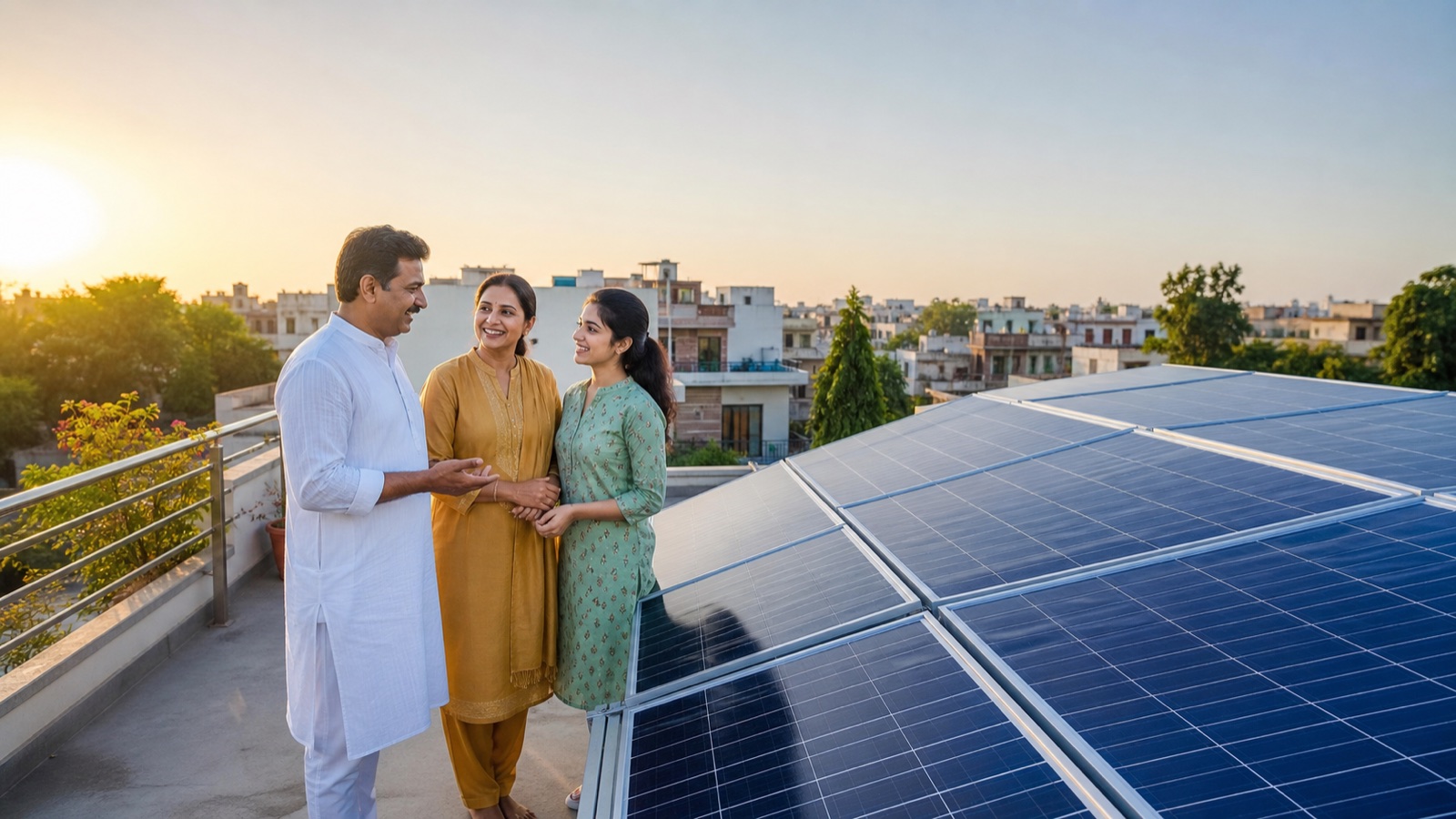
Understand bill savings, tariff protection, break-even, maintenance and the honest limits of the zero-bill promise.
Open benefits guide →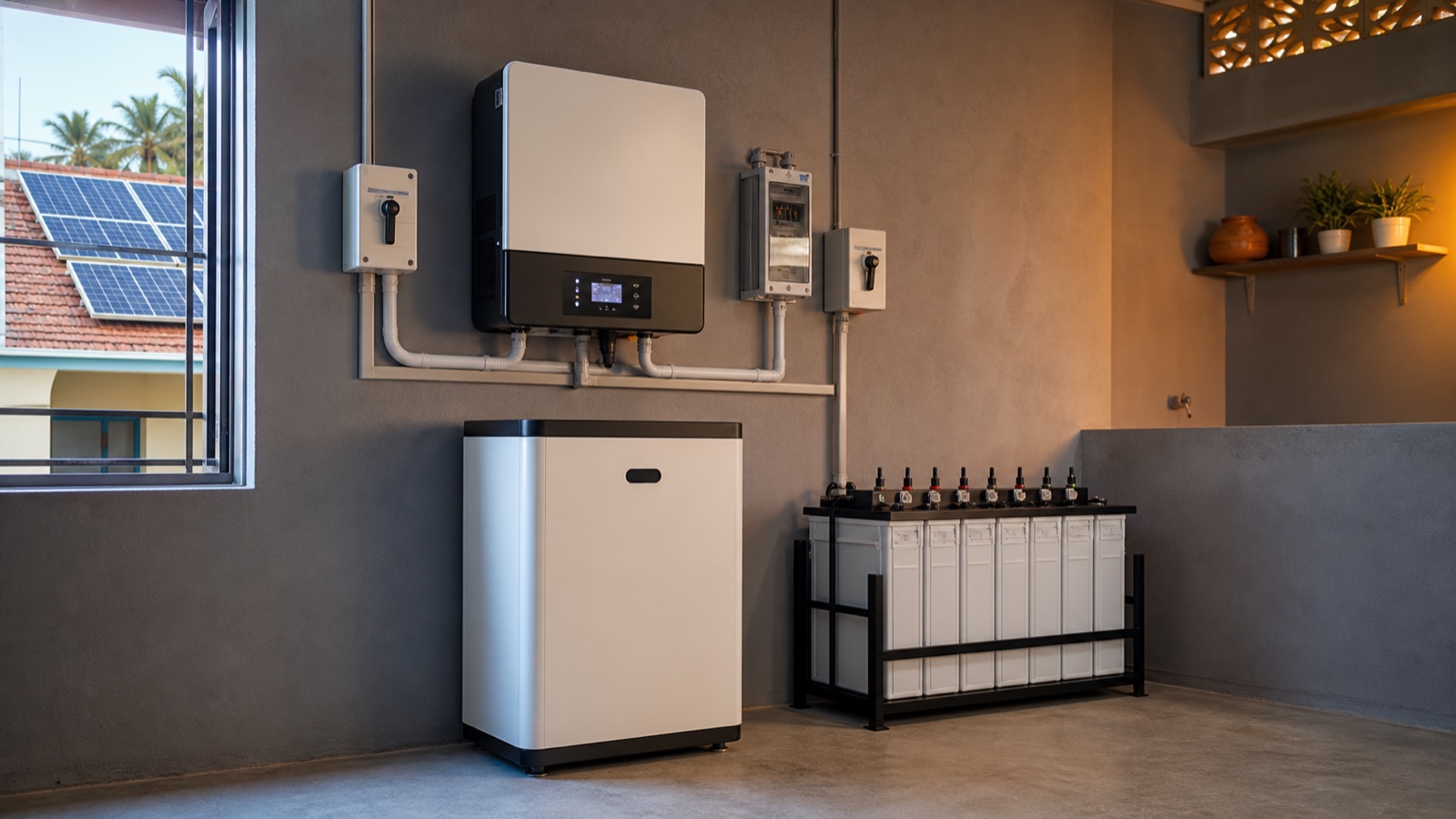
Compare backup purpose, usable capacity, maintenance, inverter compatibility, safety and total ownership cost.
Open battery guide →Clarity before commitment
At the survey, ask for the exact panel and inverter model, DCR/ALMM eligibility, structure specification, protection devices, warranty terms and exclusions—in writing.
Confirm equipment eligibility before installation.
Earthing, surge protection, isolators and neat cable routing.
Know what is included, what is extra and what is warranted.
Monitoring help, service contact and a clear escalation path.
Good questions
Straight answers to the questions that usually delay a decision.
No installer should guarantee a government payment. The estimate combines ₹78,000 central CFA for an eligible 3 kW+ residential system and the UP additional benefit of up to ₹30,000. Eligibility, approved equipment, portal process, commissioning and prevailing rules all matter.
A standard on-grid inverter shuts down during an outage for lineman safety. If you need backup, ask for a hybrid system with compatible batteries; it costs more and needs a different design.
Plan for roughly 300 sq ft of shadow-free space. Water tanks, stair rooms, parapets and nearby buildings can reduce usable area, so a physical shadow assessment matters.
Banks set the final interest rate, tenure, processing charges and subsidy treatment after credit and project checks. The calculator uses a standard reducing-balance EMI on the estimated post-benefit cost so you can plan—not as a loan sanction.
Do not accept a generic brand list as the answer. Your final quote should state the exact manufacturer, model, wattage, technical datasheet and warranty for every major component.
Send your city and latest electricity bill on WhatsApp. Cosmic Solar can suggest a starting size and schedule a roof assessment.